Ask a jazz musician what swing is and they'll tell you the most famous response in music education history: 'If you have to ask, you'll never know.' This is unhelpful, but it points to something real: swing is a felt quality that resists precise description.
That said, we can say precisely what it is in notational terms — even if notation only captures part of it.
The notational definition
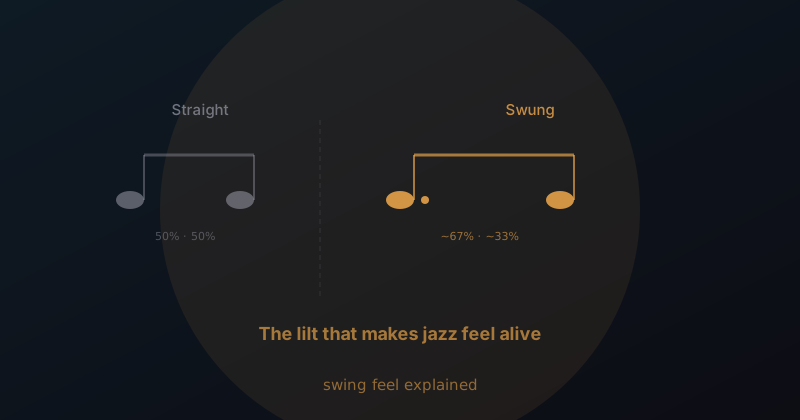
In notated music, eighth notes are played as written: the first of a pair gets exactly half a beat, the second gets exactly half a beat. This is called 'straight' eighths.
In swing, the eighth notes are played unequally: the first of a pair gets roughly two-thirds of a beat, the second gets roughly one-third. This is called 'swung' eighths, and the ratio (2:1 in theory, but variable in practice) is what creates the characteristic 'lilt' of jazz rhythm.
Written another way: two straight eighth notes (1-and) become something closer to a dotted eighth + sixteenth (1..and) in swing. The first note hangs a little longer; the 'and' comes later, with more energy.
Why the ratio varies
'Roughly two-thirds' is the important qualification. The actual ratio swings between 50:50 (straight, no swing) and 67:33 (full triplet swing) depending on tempo and context:
- At very fast tempos (145+ BPM), full triplet swing becomes physically impossible to execute cleanly, so the ratio approaches 55:45 or even 50:50. The feeling is still 'swung' because of phrasing and accent, not ratio.
- At ballad tempos (60-80 BPM), the ratio can go full 67:33 without becoming awkward. This is why ballads feel 'lazier' — the delay on the 'and' is more pronounced.
- Personal style: Different musicians have different swing ratios that become part of their sound identity. Miles Davis swung differently from Charlie Parker who swung differently from John Coltrane.
What swing does to the feel
Beyond the ratio, swing involves:
- Accent on 2 and 4: Straight music emphasises beats 1 and 3 (the 'strong' beats in 4/4). Swing emphasises beats 2 and 4 — the backbeat. This shifts the rhythmic weight forward, creating the feeling of motion.
- Phrase anticipation: Jazz soloists frequently start phrases before the beat and resolve them on the beat, creating a forward-leaning quality. The melody seems to rush toward harmonic resolution.
- Bass and drums lock: Walking bass (four quarter notes) and ride cymbal (swung eighths) create interlocking patterns that are greater than the sum of their parts. The bass beats the pulse; the cymbal fills the gaps between.
In the Mowjera jazz pieces
The JAZZ_PRESET in the @jazz_quartet collection applies swing to the bass track (swing: 0.25, a moderate ratio appropriate for medium tempos). The melody and comp tracks have high humanize values (0.20-0.22) that introduce natural timing variations simulating the feel of a live musician.
At 120 BPM (Autumn Walk), the swing sits around the 60:40 ratio — noticeable but not extreme. At 138 BPM (Minor Swing), it tightens toward 55:45. At 72 BPM (Blue Hours), the slower tempo allows the swing to breathe more. These are the same relationships real jazz musicians navigate by ear.