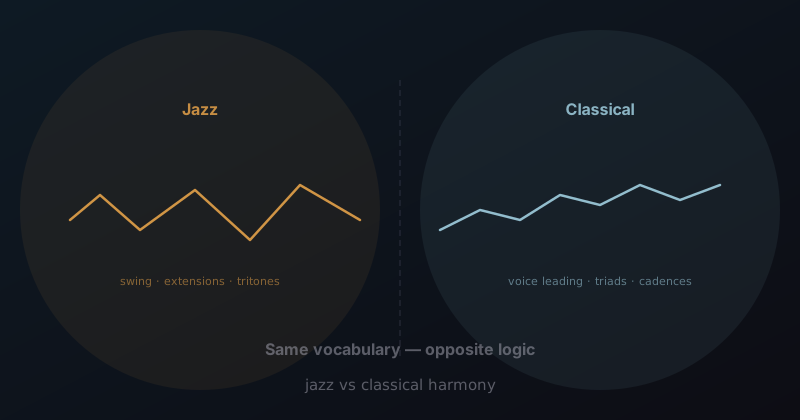
Jazz and classical music share a vocabulary — they both use major and minor chords, they both talk about dominant function and resolution, they both care intensely about voice leading. But the way they apply these tools is so different that a composer trained in one tradition will initially struggle to think in the other.
Classical harmony: voice leading as the primary constraint
Classical harmony (roughly, European music from 1600-1900) is built primarily around voice-leading rules. The fundamental question in classical harmonic analysis is not "what chord comes next?" but "where does each voice go next?"
This produces specific constraints: - Parallel fifths and octaves are avoided: If two voices move in the same direction by the same interval (both moving up a fifth), the independence of the voices collapses. Classical counterpoint treats this as an error. - The soprano voice should be singable: The melody shouldn't jump more than an octave, and large jumps should be resolved by stepwise motion in the opposite direction. - The leading tone must resolve: The seventh scale degree (B in C major) almost always moves up to the tonic in classical harmony.
Jazz harmony: chord colour as the primary concern
Jazz harmony (broadly, American music from 1920-present) is built primarily around chord colour. The fundamental question is not "where does each voice go?" but "what does this chord sound like, and how does it contrast with the next?"
This produces different priorities: - Parallel motion is acceptable: Jazz voicings often move in parallel motion (two voices moving in the same direction). This is not an error — it's a texture choice. - Extended notes are expected: A C major chord in classical music is C-E-G. A Cmaj7 in jazz is C-E-G-B. A Cmaj9 is C-E-G-B-D. These extensions aren't decorations — they're the basic sound. - The leading tone can go anywhere: The B in a G7 chord doesn't need to resolve to C. It can descend chromatically, or stay on B for a Cmaj7 voicing. Jazz treats voice-leading as a stylistic choice, not a rule.
The tritone difference
Both traditions handle the tritone, but differently: - Classical: The tritone in a dominant seventh chord (B–F in G7) must resolve inward to the third of the I chord (C–E in Cmaj7). Both voices must move. - Jazz: The tritone can be left unresolved, used as a shell voicing without resolution, or resolved to an unexpected chord via tritone substitution.
What Mowjera's classical and jazz collections demonstrate
Compare @chamber_ensemble's classical pieces with @jazz_quartet's jazz pieces. The classical pieces use similar I-V-IV-I and I-vi-IV-V progressions, but the string voicings use three-note triads and the bass moves mainly on whole notes. The jazz pieces use shell voicings (two notes, 3rd+7th), and the bass moves on every quarter beat.
Same harmonic vocabulary. Different architecture. Both are trying to make chords move through time in a satisfying way — they've just decided that 'satisfying' means something different.