The tritone substitution is one of those music theory concepts that sounds complicated until you understand why it works — then it becomes obvious, even inevitable.
The setup
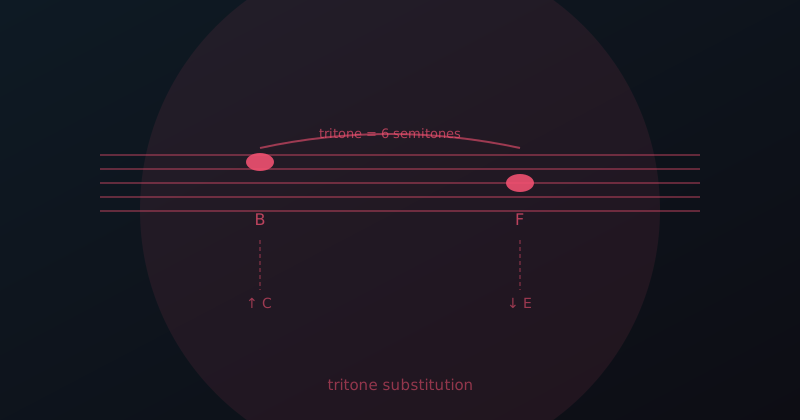
Any dominant seventh chord contains exactly one tritone: the interval between its third and seventh. In G7 (G–B–D–F), the tritone is B–F. That tritone is the source of the chord's tension, because both notes want to resolve: B rises to C, F falls to E. Both resolutions are in C major.
Now here's the trick: another chord contains the exact same tritone, just respelled. Db7 (Db–F–Ab–Cb) has an F and a Cb, which is enharmonically equivalent to B. The tritone in Db7 is F–B — the same tritone as in G7, just inverted.
The substitution
Because Db7 contains the same tritone as G7, it resolves to C with the same internal voice-leading logic: F falls to E (or rises to Gb), B (= Cb) rises to C. The resolution works.
But the bass movement is different. G7 → Cmaj7 is a root movement of a fifth downward (or a fourth upward). Db7 → Cmaj7 is a root movement of a half step downward. That chromatic bass movement is smoother, more colourful, and gives the approach chord a different flavour — darker, more sophisticated, slightly unexpected.
Why jazz musicians use it
The half-step bass movement that tritone substitution creates is prized in jazz for two reasons:
- Smoothness: A bass line descending by half steps is more connected than one jumping by fourths or fifths. Walking bass lines built with tritone substitutions feel luxurious.
- Colour: The substituted chord contains notes outside the home key (Db and Ab in a C major context), introducing chromatic colour that keeps the harmony interesting across many repetitions.
In practice, jazz musicians often alternate between the original dominant chord and its tritone substitute, or use the substitute on the repeat of a phrase to create variety.
In the Mowjera jazz pieces
The shell voicings @jazz_quartet uses in the comp tracks are built around this principle. Every F7 chord (in Autumn Walk and Blue Hours) uses the shell A3+Eb4 — the tritone that defines the chord. Every G7 (in Late Session and Cool Blue) uses B3+F4. Every E7 (in Minor Swing) uses G#3+D4.
These tritones are the harmonic skeleton. The melody and bass flesh them out.
When you're listening to jazz and you hear a chord that sounds slightly unexpected just before the resolution, that's often a tritone substitution. Once you know what to listen for, you'll hear it everywhere.