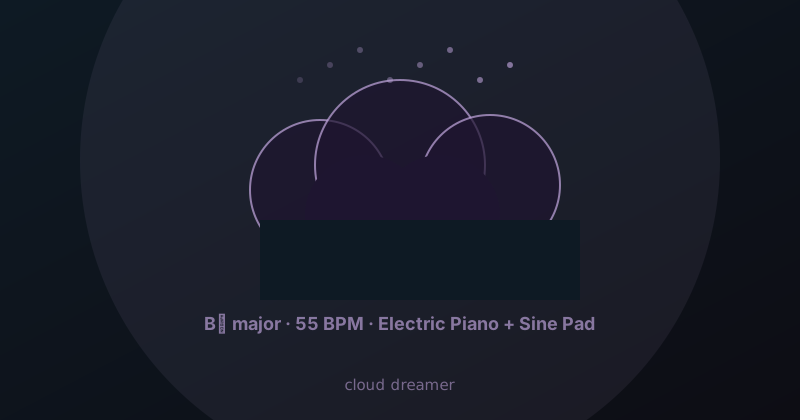
There's an old debate in music theory about whether different major keys have distinct characters, or whether they're all functionally equivalent transpositions of the same diatonic template. On a modern equal-tempered instrument, C major and Bb major contain exactly the same intervals. Transpose every note in a C major piece up by a minor third and you have Bb major — the relationships are unchanged.
And yet: Cloud Dreamer needed to be in Bb major. No other key would have worked for what I was trying to do.
The case against key color
The skeptical position is straightforward. Human pitch perception is relative, not absolute. Most listeners don't have perfect pitch. A melody played in C major sounds the same to them as the same melody in Bb major — because the intervals, the emotional contour, the relative motion from note to note are all identical. What could possibly be different?
The answer, in purely psychoacoustic terms: not much. Studies of listeners without perfect pitch show minimal differential response to different major keys when melodies are equalized for tempo and instrumentation.
The case for key color
But there are factors that psychoacoustic equivalence doesn't account for.
Instrument-specific resonance. Different keys resonate differently on different instruments due to their construction. On piano, Bb major involves more black keys, which have a slightly different touch and a slightly different tonal quality on most instruments — particularly acoustic pianos. On guitar, open strings resonate in keys that include E, A, D, G, B — not Bb. A guitarist playing in Bb must barre or use capo, which changes the instrument's acoustic character.
For electric piano (the voice in Cloud Dreamer), the effect is less pronounced — but the specific quality of certain notes in the Bb major scale, particularly Bb4 itself (MIDI pitch 70), sits in a resonance window of most electric piano samples that gives it a slightly warmer, rounder character than C4 or D4.
Register. Choosing Bb major as opposed to C or D shifts where the melody sits in pitch space. At comparable tempos and register choices, a Bb major melody tends to sit slightly lower (the root is lower, the peak is lower) than the same melody in C. Lower registers sound warmer. This is not key color in the mystical sense — it's physics. But the emotional effect is real.
Historical and cultural association. Bb major has been used frequently in jazz and soul for warm, intimate contexts: ballads, late-night mood pieces. While these associations are learned rather than inherent, they accumulate over a listener's lifetime. Bb feels warm partly because it has been consistently used in warm contexts.
What Bb major does in Cloud Dreamer
Cloud Dreamer is the slowest and most floating piece in the collection — 55 BPM, electric piano, sine pad, virtually no bass activity. The goal was music that felt genuinely weightless, like the sensation of lying in a field looking up.
The specific pitch of Bb4 (the tonic, repeated throughout the melody) has a quality on electric piano that C4 doesn't. It's rounder, slightly darker, with less of the brightness that C4 carries. The piece's signature moment — the long hold on Bb4 in the final bar — needed that roundness. On C4, the same held note would sound slightly cleaner, slightly more declarative. On Bb4, it settles.
The progression (Bb–F–Gm–Eb) also has a warmth that C–G–Am–F doesn't quite match. The Eb chord (IV of Bb) has a soft, padded quality — the flatted key gives the subdominant chord a different acoustic character than F (the IV of C). Eb major, with its three flats, is the warmest of the flat-key major chords.
The sine pad choice
Cloud Dreamer uses a sine pad — a synthesized voice that is literally a sine wave, the purest possible tone with no overtones. Sine waves have no timbral complexity: what you hear is entirely the fundamental frequency, nothing else.
This makes sine pads essentially invisible as harmonic support. They hold pitch without adding color. The chord is implied rather than stated. In Bb major, the sine pad holds Bb3–D4–F4 for each Bb chord — you hear a slight warmth added to the space below the melody, but nothing that calls attention to itself.
In a busier piece, a sine pad would sound thin. In Cloud Dreamer, with its extreme sparseness, the sine pad is exactly right: it adds presence without adding sound in any way you'd notice consciously. Like atmosphere.
A note on floating
The word I kept returning to while composing Cloud Dreamer was "float." Not drift — drift implies a lack of direction. Not fly — fly implies effort. Float: supported by something you can't see, going somewhere by the force of imperceptible currents, not quite connected to the ground.
Bb major at 55 BPM with an electric piano, a sine pad, and a cello bass moving in whole notes makes floating possible. C major might have made it pretty. Bb major makes it hover.