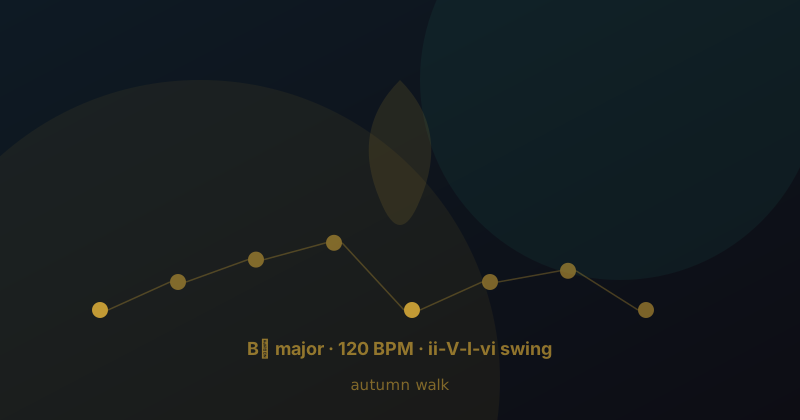
Autumn Walk started with a key choice: Bb major.
Bb major is the most common key in jazz for a reason that's partly acoustic and partly historical. Bb is a transposing key for the tenor saxophone (a Bb instrument that sounds an octave and a whole step below written pitch), which means when a tenor player plays "in C," the concert pitch is Bb. Because the saxophone dominated jazz in the bebop era (Charlie Parker, Sonny Rollins, John Coltrane), compositions clustered around saxophone-friendly keys: Bb, Eb, F, and their relatives.
The acoustic reason is subtler: Bb major has a slightly warmer, rounder quality than C major (no sharps, no flats) because its overtone series interacts differently with room acoustics. Live jazz in Bb major has a physical warmth that C major doesn't.
The progression
The ii-V-I-vi in Bb major (Cm7–F7–Bbmaj7–Gm7) was chosen because it moves through the entire key while keeping the harmonic rhythm slow enough to hear each chord clearly at 120 BPM. Two beats per chord at this tempo gives each chord roughly one second — enough time to register, not so long as to become static.
The Gm7 at bar 4 is the vi chord of Bb major, which is the relative minor. This creates a moment of tonal ambiguity: is Gm7 a vi chord in Bb major, or are we briefly in G minor? The repeat immediately answers: we're in Bb, because bar 5 returns to Cm7 and the ii-V-I cycle continues.
The melody
The electric piano melody was designed with a specific arc: start on Eb5 (the blue note — the minor third — of Bb major), descend through the first phrase, then build across bars 5-6 to peak on G5 (the sixth of Bb major, which has a particularly open sound on electric piano), then descend to the tonic Bb4 held for the final bar.
The opening Eb5–D5–C5–Bb4 phrase (bars 1-2 in the descent sense) is the mirror of the ascending run in bars 5-6, giving the piece a symmetric arch shape over its 8 bars.
The walking bass strategy
The bass in Autumn Walk uses three different techniques across the 8 bars:
- Chord-tone walking (bars 1-4): Each bar steps through the chord tones in sequence — root, third, fifth, seventh — giving the clearest possible harmonic outline.
- Chromatic passing notes (bar 5, Cm7): C3–D3–Eb3–E3, where E3 is a chromatic approach to F3 (the root of F7 that follows). The half-step E3→F3 creates anticipation.
- Scalar descent (bar 8): Bb3–F3–D3–Bb2, a descending Bb major arpeggio that lands back at the tonic root.
These three techniques alternate to keep the bass from becoming mechanical — the listener's ear expects the chord-tone pattern and is occasionally surprised by the chromatic or scalar variation.