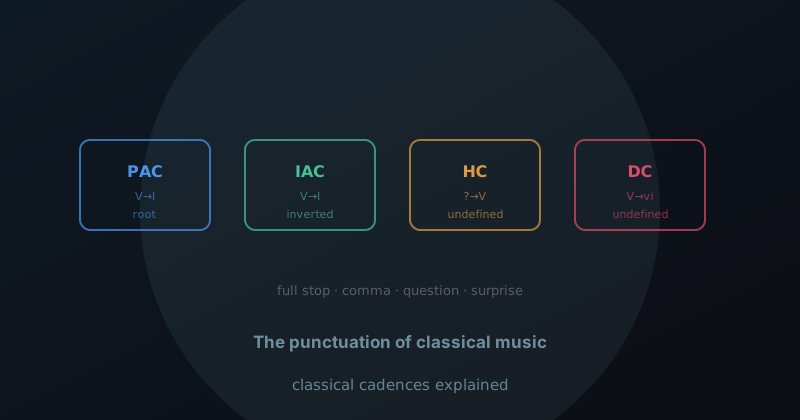
If counterpoint is the grammar of classical music, cadences are the punctuation. They're the moments when a phrase comes to rest — or doesn't quite rest, and pushes forward into the next phrase.
Understanding cadences is understanding what makes classical music feel resolved or unresolved, complete or expectant.
Perfect Authentic Cadence (PAC)
The PAC is the full stop of classical music. It occurs when the V chord (dominant, usually in root position) resolves to the I chord (tonic, in root position), with the melody arriving on the tonic note. In C major: G major (or G7) → C major, with C in the highest voice.
Every classical piece ends with a PAC or a series of them. The final bars of a Beethoven symphony might repeat the PAC six or eight times — tonic–dominant–tonic–dominant — because one isn't enough to confirm the key after an hour of harmonic adventure.
Imperfect Authentic Cadence (IAC)
The IAC uses the same V–I motion as the PAC, but either the chords are inverted (not in root position) or the melody doesn't arrive on the tonic. This creates a softer, less definitive ending — a comma rather than a full stop. IACs typically occur at the end of the first phrase in an eight-bar period, leaving the music slightly open for the second phrase to complete.
Half Cadence (HC)
A half cadence ends on the dominant (V chord), not the tonic. This is a question rather than an answer. In the period form (antecedent + consequent), the antecedent phrase typically ends with a half cadence, creating harmonic incompleteness that the consequent phrase then resolves.
Half cadences are the primary tool for building tension across phrase boundaries. When you feel that a piece 'needs' to go somewhere after a phrase ends, you've probably just heard a half cadence.
Deceptive Cadence (DC)
The deceptive cadence is the most surprising: the V chord is followed by the VI chord (submediant) instead of the expected I. In C major, this is G major → A minor instead of G major → C major.
The deceptive cadence works because the ear is primed for the V–I resolution — and then the VI appears, harmonically related enough to not be dissonant, but wrong enough to create surprise. Composers use it to extend a phrase that would otherwise have ended, or to add an unexpected emotional turn.
In Mowjera's classical pieces
@chamber_ensemble's pieces all end with Perfect Authentic Cadences — V chord in the penultimate bar, I chord on the final bar, melody on the tonic note. In Spring Prelude, the final bar is a D major arpeggio descending from D5 to D4 — the tonic in both the highest and lowest pitches of the bar.
The middle of each piece uses half cadences to create the sense of incompleteness that makes the return to the tonic feel earned. In the Moonlit Adagio, the Bb chord at bar 4 is a half cadence in the relative major (Eb major): the music pauses on the dominant before the second half's build toward the final Cm resolution.
Cadences are how classical composers controlled the listener's sense of direction. Every formal decision in classical music — phrase length, key choice, tempo, harmonic rhythm — feeds into the cadential structure.