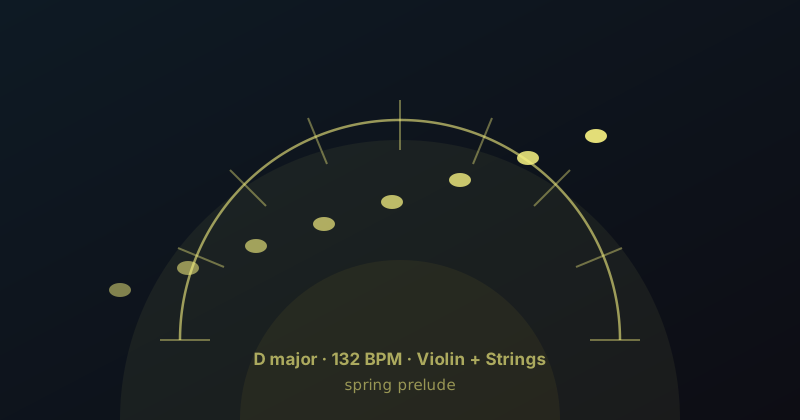
Spring Prelude was composed with one primary intention: to demonstrate what a violin does when it's moving fast in a bright key.
D major is the violin's native key in a specific acoustic sense. The violin is tuned G–D–A–E (bottom to top), and two of those open strings (D and A) are the tonic and dominant of D major. When you play a D major scale on violin, the open D and A strings ring sympathetically underneath every note, adding natural resonance that doesn't occur in other keys. D major on violin sounds fuller, warmer, and more vibrant than D major on piano — not because of any property of the pitches themselves, but because of how string instruments resonate.
Why Allegro
At 132 BPM, each note is short enough that the ear processes the melody as a shape rather than a sequence of individual pitches. You don't hear 'D5–E5–D5–B4–D5' — you hear 'a descending figure in the upper register.' This perceptual shift is what Allegro tempo creates: the music becomes gesture and shape, not note-by-note narration.
This is why the scale run in bar 5 works. Played slowly (Adagio), a D major scale (D4–E4–F#4–G4–A4–B4–C#5–D5) would sound like a technical exercise. At 132 BPM, it becomes kinetic: the ear hears it as a single rising gesture, a swoosh from D4 to D5, with the individual notes blurring into directional energy.
The I-V-IV-I progression
The progression (D–A–G–D) was chosen for its harmonic clarity. I-V-IV-I is not a 'sophisticated' progression — it's the most basic harmonic statement in Western music, the same three chords used in folk songs and blues. But at Allegro tempo with a violin melody, its simplicity is a strength: the listener never has to catch up with an unexpected chord change. The harmony is already known before the melody lands on it.
The A chord in bar 2 creates a moment of harmonic brightness: the note A5 (the open A string at its highest resonant octave) can ring above the chord, adding natural reverb to the held note. In bar 6, the peak is A5 again — but now it's reached from below by a two-octave scale run, so the peak feels earned rather than stated.
The descent
Bars 7-8 descend from the G major of bar 7 back to D in bar 8: G5–F#5–E5–D5, then D5–A4–F#4–D4, landing on the lowest D in the melody range. This two-octave descent mirrors the two-octave ascent in bar 5, giving the piece a symmetric arch shape.
The final bar (D5–A4–F#4–D4) is a D major arpeggio descending — the simplest possible ending for a piece in D major, which makes it feel inevitable. Everything in the piece was moving toward this conclusion.