'Comping' — short for accompanying or complementing — is what the piano does when it's not playing the melody. In a jazz trio, the pianist comps behind the bass player's walking lines and the soloist's improvisation, providing harmonic context without filling all the space.
It is, by definition, a supporting role. And it requires a different kind of musical intelligence than soloing.
The first rule: Listen
The most fundamental comping error is not choosing the wrong chord voicing — it's not listening to what the soloist is playing. A comping pianist who isn't listening will double the melody (play the same note the soloist just played), clash with the soloist's implied harmony, or play in the wrong register.
Good comping is reactive. You hear what the soloist plays, you respond to it. If the soloist just played a long, sustained note in the upper register, you might respond with a chord stab in the middle register that answers it. If the soloist is playing a fast run, you might hold back entirely and let the bass carry the harmony.
The voicing question
Shell voicings (3rd + 7th) are the standard starting point for jazz piano comping because they leave the most space. They tell the soloist what chord is happening without crowding the register. On a Dm7, playing F3 and C4 (3rd and 7th) in the middle register leaves the entire upper register free for the soloist.
More complex voicings — with ninths, elevenths, thirteenths — are used when the harmony needs more colour, or when the soloist is playing in a register that allows it.
When to play
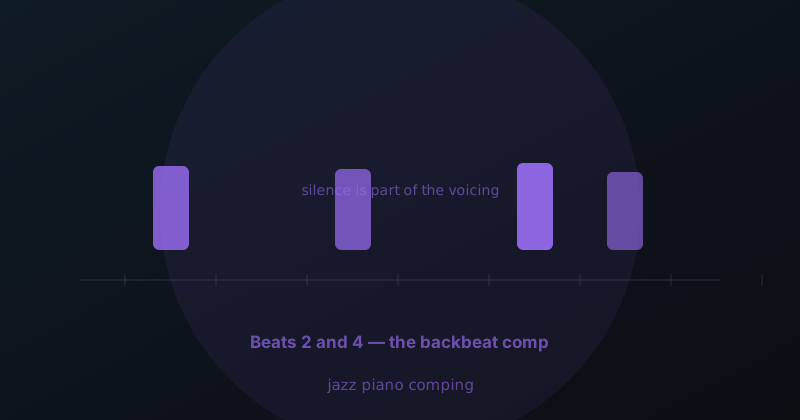
The standard jazz comping rhythm is off-beats: beats 2 and 4, or the 'and' of beats. This places the comping chords where the swing emphasis already is, reinforcing the rhythmic feel without competing with the walking bass (which is on every beat).
But this is a starting point, not a rule. The best comping is more conversational: you listen to what the rhythm section establishes, you respond to what the soloist does, and you fill gaps where the harmony needs reinforcement. Sometimes that's a chord on beat 1. Sometimes it's a 'bomb' (a sudden accent) in the middle of a bar. Sometimes it's nothing for two bars.
In Mowjera's jazz pieces
The atmosphere tracks in @jazz_quartet's collection use whole-note shell voicings held for the entire bar — a simplified approach that provides harmonic context without rhythmic activity. In a live context, a jazz pianist would vary this extensively. But the effect demonstrates the principle: two notes (3rd + 7th), low volume, middle register, sustained — maximum harmonic information, minimum interference.
The key insight is that comping is additive to a texture that is already complete without it. The walking bass and melody are sufficient. Comping makes them richer, not louder.