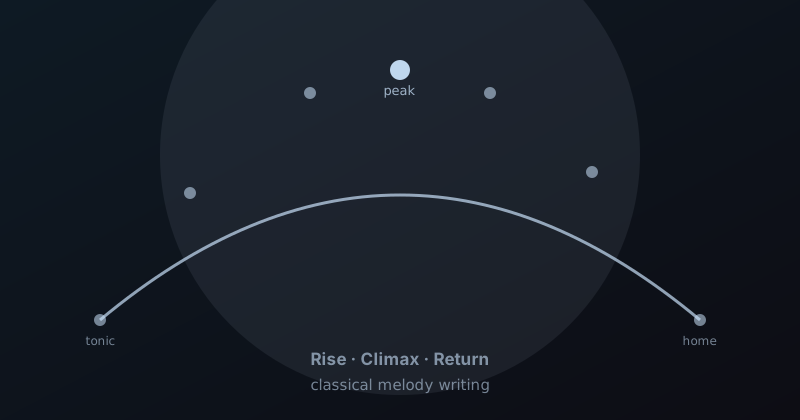
A classical melody is not just a sequence of notes. It's a phrase — something with a beginning, a middle, a climax, and a return. The great classical composers (Haydn, Mozart, Beethoven, and their contemporaries) thought about melody as a kind of sentence: it needs to go somewhere, arrive somewhere, and then come to rest.
The formal study of this is called 'phrase structure,' and it reveals principles that apply across centuries of Western melody.
The four-bar phrase
The basic unit of classical melody is the four-bar phrase, and virtually everything in the classical tradition can be understood as a manipulation of this unit. A four-bar phrase typically:
- Establishes the key and starting pitch (bar 1)
- Creates motion away from the tonic (bars 2-3)
- Returns to the tonic or creates tension for the next phrase (bar 4)
The eight-bar period (two four-bar phrases) is the standard complete formal unit: an 'antecedent' phrase (ending on the dominant or a half cadence) followed by a 'consequent' phrase (ending on the tonic).
The melodic arc
Within a phrase, the melody follows an arc: it rises to a peak (the melodic climax) and descends from it. The peak is almost never on the first note — it usually arrives in the second half of the phrase, creating a sense of arrival before the descent.
The placement of the peak matters: - Early peak (bars 1-2): creates a sense of immediate urgency, then gradual relaxation - Middle peak (bar 3 of 4): the most common position — enough build-up to feel earned - Late peak (bar 3-4 and then 7-8 of an 8-bar period): the most satisfying arc, used in the most lyrical melodies
Stepwise motion and leaps
Classical melody theory (following treatises from Zarlino to Schoenberg) distinguishes between stepwise motion (moving by seconds) and leaps (moving by thirds or larger). The general principle: stepwise motion is more restful, leaps create more energy and need resolution.
When a melody makes a large leap (a sixth or octave), classical practice suggests the next move should be stepwise in the opposite direction, resolving the energy of the leap. In the Andante Cantabile (bar 4 of @chamber_ensemble's piece), the melody peaks on G#5 then drops to F#5 — a second, the most resolved possible continuation after the peak.
Return and resolution
Classical melodies almost always end by returning to the tonic pitch (the first note or the key centre). This creates the sense of completion. If the melody begins on the third scale degree (E in C major), it will almost always arrive on C at the end. If it begins on the fifth (G), it will arrive on C.
The piece's final note and its approach to that note (the cadence) determine the emotional character of the ending: a perfect authentic cadence (V–I with both voices landing on the tonic) feels complete; a plagal cadence (IV–I) feels calm; a half cadence (any chord–V) feels open.
In the Mowjera classical collection, every piece ends on the tonic pitch with a strong beat — a consistent choice that gives each piece a sense of resolution and rest.