Composing music for therapeutic use is a different discipline from composing for concert, film, or games. It is not harder or less creative — but it requires different priorities, different constraints, and a working understanding of the physiological and psychological mechanisms that make music effective as a clinical tool.
This guide covers the compositional variables that matter most, what the research tells us about each, and how to make informed decisions when writing music intended for therapeutic contexts.
Tempo: the single most important variable
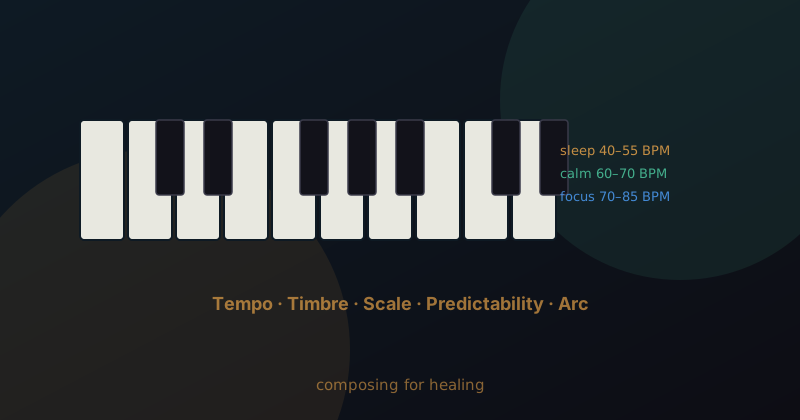
Tempo is the most powerful parameter in therapeutic music because it is the primary driver of neural and cardiovascular entrainment. Before deciding anything else about a piece, decide what physiological state you're targeting and what tempo serves that state.
General guidance by application:
| Target state | Tempo range | Rationale |
|---|---|---|
| Deep relaxation / anxiety reduction | 50–65 BPM | Below resting heart rate; pulls autonomic tone downward |
| Sleep onset | 40–55 BPM | Below resting HR; promotes delta oscillation |
| Calm focus / cognitive work | 60–80 BPM | Resting rate range; maintains alertness without arousal |
| Movement / gait training | 80–120 BPM | Above resting rate; motor activation for physical therapy |
| Mood activation / depression | 72–100 BPM | Mild energizing without sympathetic arousal |
Within these ranges, consistency matters more than precision. A piece that gradually accelerates or decelerates will disrupt entrainment. Therapeutic music maintains a steady tempo with very low rhythmic complexity.
Key and scale selection
Major vs. minor is not simply "happy vs. sad." The clinical picture is more nuanced:
- Major keys produce faster autonomic responses in most listeners (slightly higher heart rate, faster skin conductance response) compared to minor keys.
- Minor keys allow emotional depth and complexity that some therapeutic applications require — grief work, for example, needs music that can hold sadness, not just reflect it.
- Pentatonic scales (both major and minor) have a unique property for therapeutic use: they contain no tritones and no leading tones that create strong harmonic tension and demand resolution. A listener can focus on the music rather than tracking unresolved harmonic motion.
For most relaxation and anxiety applications: major pentatonic, major, or modes with major thirds (Lydian, Mixolydian). For grief and emotional processing: natural minor, Aeolian, or Dorian. For sleep: Eb major pentatonic, C major pentatonic, or any pentatonic scale — no dissonance possible.
Harmonic rhythm (how often chords change) is as important as the chords themselves. For relaxation, chord changes should be slow — no faster than once per bar, ideally once every two bars. Rapid harmonic rhythm requires the listener's attention to track changes, which maintains cognitive arousal.
Instrumentation: timbre and the autonomic nervous system
The frequency content of instrument timbres has measurable autonomic effects:
Calming timbres (predominantly low fundamentals, few high overtones, smooth attack): - Cello, contrabass, low piano register - Muted or dampened strings - Sine-wave and soft pad synthesizers - Low-register flute (not piccolo) - Harp (brief attack, clean decay)
Arousing timbres (high-frequency content, complex overtone series, sharp attack): - Trumpet, trombone, bright brass - Distorted guitar or heavy synth - Cymbals, hi-hats, crash percussion - Piccolo, high-register flute - Bright electric piano or harpsichord
For most therapeutic applications, avoid instruments in the second category. For movement therapy and mood activation, controlled use of higher-energy timbres may be appropriate.
Avoid lyrics. Vocal music with text activates language processing areas in the brain (Broca's area, Wernicke's area), which maintains cognitive arousal. For relaxation, sleep, pain management, and most anxiety applications, wordless music is significantly more effective. The exception: when the therapeutic goal involves emotional connection to a text (as in grief work with personally meaningful songs).
Structural predictability
For most therapeutic applications — especially anxiety, autism, and sleep — predictability is a feature, not a limitation.
Phrase length consistency: Use regular 4-bar or 8-bar phrases. Do not vary phrase lengths unpredictably. Listeners build temporal expectations based on phrase length, and violating those expectations generates mild arousal — useful in concert music, counterproductive in therapy.
Repetition: Therapeutic music repeats. The same melodic material returns. Listeners who know what's coming next are not anxious about what's coming next. This is the musical equivalent of a safe, predictable environment.
No sudden dynamic changes: A sudden loud passage breaks the parasympathetic response that slow music has been building. Therapeutic music uses smooth dynamic gradients — crescendi and decrescendi over multiple bars — not sudden accents.
Melodic range and contour: Melodies for relaxation should move primarily in stepwise motion (no large leaps), stay within a comfortable mid-range (avoiding very high pitches that increase arousal), and have gently arcing contours that resolve downward or stay level rather than rising urgently.
The ISO principle in composition
When composing music for a therapeutic arc — a piece intended to guide a listener from one state to another — the ISO principle applies. You cannot begin with the target state; you must begin where the listener is.
For an anxiety reduction piece, this might mean: - Opening at 70–80 BPM with slightly more rhythmic complexity - Gradually reducing tempo over the piece (or between movements) toward 55–60 BPM - Reducing harmonic rhythm and melodic density as the piece progresses - Ending with longer notes, longer rests, and fewer active voices
This compositional arc is the musical equivalent of the therapeutic process: meet before you lead.
Documentation for clinical use
If you are composing music for clinical use, document the compositional choices that are clinically relevant: tempo, key, scale type, primary instruments, harmonic rhythm. This allows clinicians to make informed selections rather than guessing based on title or impressionistic description.
Mowjera's therapy collection includes this documentation in each piece's description — not as an afterthought but as part of the compositional brief. A clinician can read "F major, 52 BPM, whole notes, piano + cello, designed for 4-count breath pacing" and make a clinical judgment about whether that piece fits their patient's needs without listening first. That's what clinically useful documentation looks like.
A starting brief for therapeutic composition
Before writing a single note, answer these questions:
- What is the clinical application? (anxiety reduction, sleep, grief, movement, focus)
- What physiological state is the target? (lowered heart rate and respiration, sleep onset, mild activation)
- What tempo serves that state?
- What instruments are available and appropriate?
- What key and scale type — and what does the harmonic language need to feel like?
- How much predictability is required by the population?
- Is there a therapeutic arc to the piece, or is it designed to loop in a steady state?
Answering these questions before writing transforms composition from a creative exercise into a clinical design process. Both are valid. Only one of them produces music that reliably helps people.
The music therapy collection on Mowjera is an attempt to show what that design process produces: seven pieces built from clinical briefs, with instrumentation, tempo, and structure chosen to serve specific therapeutic goals. They are free, documented, and playable in the browser — open for use, adaptation, and critique.