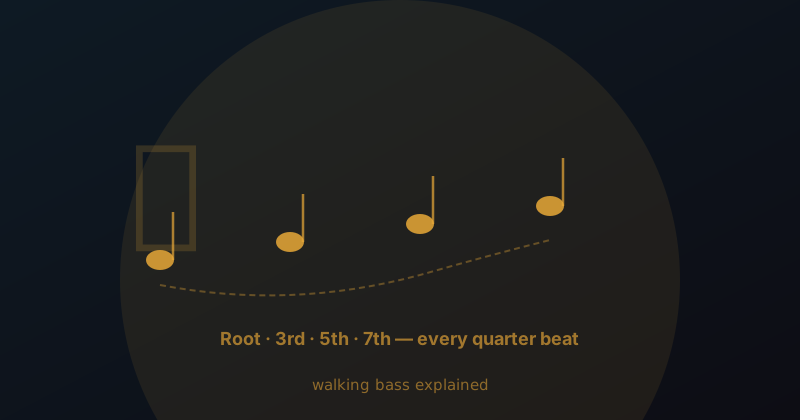
The walking bass line is one of the most distinctive sounds in Western music. You recognise it immediately: a steady, purposeful quarter-note movement in the low register, stepping through chord tones and passing notes, never landing twice on the same note if it can help it, always pulling the music forward. It's the sound underneath Bill Evans. Underneath Miles Davis. Underneath virtually every jazz recording made between 1930 and 1975.
What makes it interesting as a compositional object is that it solves three separate musical problems simultaneously.
Problem 1: Marking the beat
In early jazz, before the bass drum was used consistently, the bass (then usually tuba or string bass) was responsible for the rhythmic foundation of the ensemble. Four quarter notes per bar became the standard partly for practical reasons: it was the easiest way for a large ensemble to stay together. You could feel where beat 1 was because it was four steps from the last beat 1.
But once the convention was established, composers realised it had a secondary benefit: a bass line moving on every beat is almost impossible to lose your place in. The listener's body responds to the regularity. This is why jazz and blues venues don't feel distracting to have a conversation in — the bass keeps the room anchored without demanding attention.
Problem 2: Outlining the harmony
The 'walking' part of the walking bass refers to the fact that the bass doesn't stay on the root of each chord — it moves through it. A skilled bass player on a Dm7 chord might play D–F–A–C, hitting all four chord tones in sequence. On the next chord (G7), they might play G–B–D–F. Then on Cmaj7: C–E–G–B.
This sequence — D–F–A–C–G–B–D–F–C–E–G–B — is the bass line for a ii-V-I progression in C, and it outlines the harmony so clearly that you could remove the piano and guitar entirely and still identify every chord. The bass is doing harmonic analysis in real time, with your feet.
Problem 3: Creating momentum with chromatic approach notes
The most sophisticated walking bass lines add chromatic approach notes: a pitch a half-step below or above the next chord tone, played on beat 4 to create anticipation. If the next chord is C, the approach note might be B natural or C# — both resolve satisfyingly to C. This is the reason walking bass lines so often sound like they're going somewhere: the approach note is a tiny promise the resolution fulfils.
In the Mowjera jazz collection, @jazz_quartet uses this technique explicitly in Autumn Walk: bar 5 (Cm7) walks C3–D3–Eb3–E3, where E3 is a chromatic approach to F3 (the root of the F7 that follows). In Bossa Mornings, bar 1 walks G2–B2–D3–F#3, where F#3 approaches G3 (the continuation of the G harmony).
Why the bass 'walks'
The walking metaphor is exact: the bass moves the way a person walks — one foot after another, steady, forward, each step placed deliberately. When a bass line rushes or stumbles, you can feel it the same way you'd feel someone walking irregularly beside you. When it walks well, you barely notice it — it just keeps everything moving forward at the right pace, without fuss.
That invisibility is the achievement. The best walking bass lines are the ones you don't notice until they stop.
Browse the jazz collection to hear these ideas in action across seven pieces at tempos from 72 to 145 BPM.