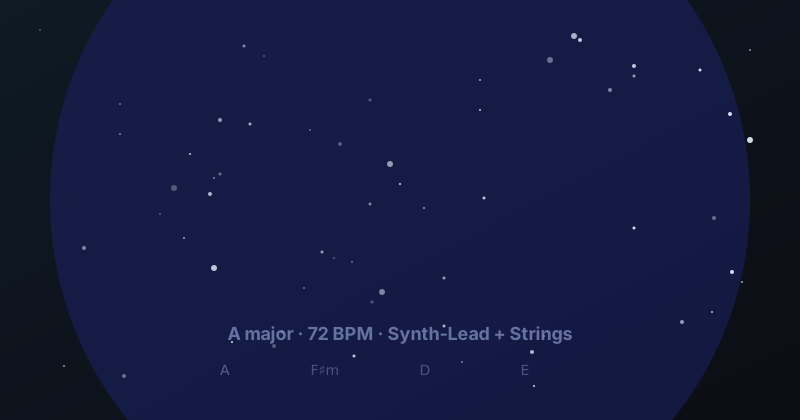
Every piece in Mowjera's New Age collection uses piano in some role except one: Starfield. Its melody is played by a synthesizer — specifically a sustained lead synth with a slow attack and no percussive transient. The harmony is held by strings. The bass is a smooth synth-bass. There is no piano anywhere in the piece.
This was a deliberate departure, and it changed almost everything about how the piece had to be written.
Why synth instead of piano
Piano is a percussion instrument. When you press a key, a hammer strikes a string — the attack is immediate, and the decay begins immediately afterward. This gives piano melody a quality of arrival and release: each note is a small event, clearly distinguishable from what preceded and follows it.
A sustained synth lead has no hammer. The note appears, swells, and stays — volume is controlled by modulation rather than decay. When two synth notes overlap (with legato playing), there is no gap between them, no moment of silence that separates one note from the next. The melody becomes liquid rather than punctuated.
For Starfield, I wanted a melody that felt like looking at stars: not arriving and departing, but continuously present, moving slowly across a fixed sky. Piano would have given the melody a pulse — a series of events. Synth removes the events and leaves the motion.
The A major choice
A major has a particular quality that C, G, and D do not: its third (C#) and seventh (G#) give it a slightly warmer, slightly more complex character than the brightest major keys. A major is the key of sunrise in many film scores — not the cool blue of dawn (that's D major) but the warm gold of mid-morning.
For a piece meant to evoke a starfield, A major seemed counterintuitive — stars are cold, not warm. But the night sky seen from a dark place has a warmth to it that cold doesn't capture: the density of light, the sense of being held within something enormous. A major's warmth serves that quality better than the cool brightness of D or the clarity of C.
The progression (A–F#m–D–E) is I–vi–IV–V — the relative minor (F#m) provides the deep color of space, D major the warm foreground, and E the anticipation of return to A.
Strings as sustained harmony
In piano-based New Age pieces, the harmony is usually implied by the arpeggio — the broken chord creates the harmonic context note by note. When you remove the arpeggio (as Starfield does — there is no arpeggio layer in this piece), the harmony has to be held explicitly.
Sustained strings at very low volume hold each chord for a full four beats. Their role is atmospheric rather than melodic — they are literally the background, the space the synth melody moves through. The voicing is three-note root position chords in the middle register (A3–C#4–E4 for A major), which sit below the synth melody range (A4–A5) without competing.
The dynamic level of the strings is kept so low (velocity 0.16–0.24) that they function more like an acoustic treatment of the space than an audible chord layer. You feel them more than hear them distinctly.
The peak at A5
Starfield reaches its melodic peak at A5 — the highest note in the entire New Age collection, two octaves above the chord root. This arrival (in bar 6, on the F#m chord) is the piece's central moment.
A5 is the fifth of D major and the second of E major — but landing on it over an F#m chord creates a brief moment where the melody note is the major seventh of the chord. In conventional music theory, that's a slight dissonance — not harsh, but present. In context, surrounded by the sustained string shimmer and the slow synth attack, it reads as a point of extreme height: the farthest from the ground the melody travels.
The descent from A5 takes almost the entire second half of the piece — six bars to come back down to A4 at the close. This long, gradual descent gives the listener time to feel the return, to experience the gravity that brings the melody home.
What New Age synth isn't
Starfield is not electronic ambient music in the Eno tradition, and it's not synthesizer pop. The synth is used as an orchestral instrument — a melody voice with the sustain characteristics of a bowed string instrument rather than a keyboard percussion instrument. It behaves like a cello that can play in the upper register. The piece has a beginning, a middle, and an end; it moves; it goes somewhere.
The difference is intentional. Electronic ambient music often works by removing direction. Starfield keeps its direction intact but changes the tone color of the instrument carrying that direction. The architecture is New Age piano. The material is synthetic.