The word 'romance' in classical music doesn't mean what it means in everyday speech. A 'romance' is a movement type — a slow, lyrical, emotionally open piece without a strict formal structure. Mozart wrote romances. Beethoven's Violin Romance Op. 40 and Op. 50 are famous examples. The word implies warmth, directness, and a lack of structural pretension: this is music that wants to be listened to, not analysed.
Romance in Bb was composed with that intention as its primary constraint.
Why Bb major
Bb major is one flat (Bb), which means it sits close to F major (one flat) and Eb major (three flats) in the key signature cycle. These keys share a characteristic: they're 'flat keys' that have a slightly warmer, rounder sound than sharp keys (G major, D major, A major) which tend to be brighter.
For violin, Bb major has an additional property: the Bb is the note that sits just above the open A string. When you play Bb on the first string (E string at the lowest position), the open A string rings sympathetically beneath it, adding warmth. The open G and D strings also resonate, contributing to the full, rounded tone that Bb violin melody is known for.
The opening phrase
The melody opens on Bb4 (bar 1, beat 1) — the tonic, placed simply and directly. This is not sophisticated: starting on the tonic states the home key immediately, without ambiguity. But the phrase doesn't stay there — it rises to C5 (beat 3), then D5 (beat 4 of bar 1), then reaches F5 in bar 2 and holds it for two and a half beats.
F5 is the fifth of Bb major, and it's the note that characterises the Bb major 'feeling' on violin: open, resonant, projecting. The half-note held on F5 in bar 2 is the emotional core of the opening section.
The peak
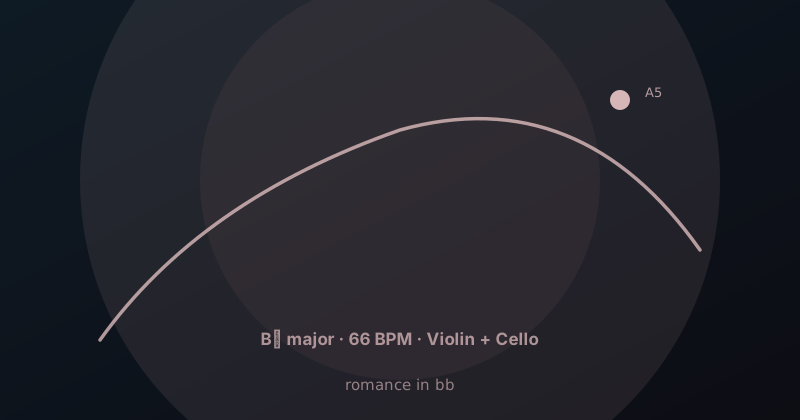
Bar 6 contains the melodic peak: A5. This is the highest note in the piece, and it's the major seventh of Bb major — the most emotionally charged note in the scale, because it sits just a half-step below the tonic octave (Bb5). The tension of A5 wanting to resolve to Bb5 is present, but @chamber_ensemble doesn't resolve it immediately: the melody descends from A5 through G5 and F5, approaching the resolution gradually.
This delayed resolution — the peak held, then descended from — is the emotional arc of the entire piece. Everything in bars 1-5 was building toward A5; everything in bars 7-8 is the resolution of that tension.
The piano-pad support
The piano-pad was chosen as the harmony instrument (instead of strings) for its warmer, more rounded sustain. Piano pads in the middle register create a bed of sound that supports violin melody without competing with it — the attack is softer than sustained strings, the decay longer, the texture more homogeneous.
This combination — violin melody + piano-pad harmony + cello bass — is essentially the sound of a Romantic piano trio in its most lyrical mode: intimate, warm, personal.
A romance succeeds when it feels like someone sharing something true, without ornamentation. That was the goal.