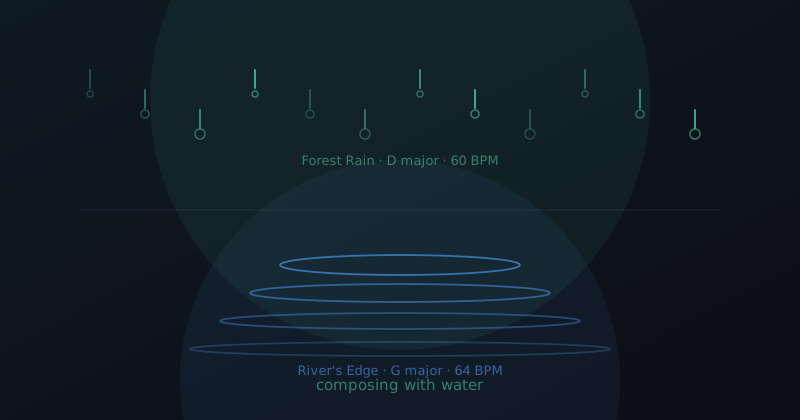
Two pieces in the New Age collection take water as their subject: Forest Rain (D major, 60 BPM, ocean flute and guitar) and River's Edge (G major, 64 BPM, piano and guitar). Both use a continuous arpeggio texture that is meant to evoke water in motion. Both are in bright major keys. Both are calm.
They feel completely different.
What rain sounds like versus what a river sounds like
This is worth thinking about before a note is written.
Rain falls vertically. Individual drops. Rhythmically irregular in the aggregate, but each drop is a distinct percussive event. The sound of rain is characterized by its density — light rain sounds like scattered events; heavy rain sounds like white noise as the events become too dense to distinguish. Rain arrives and lands; it doesn't flow.
A river flows horizontally. The water moves continuously in one direction. Individual eddies and currents create variation, but the fundamental motion is forward, uninterrupted. The sound of a river at moderate flow is a sustained broadband hiss with occasional distinct elements (a rock diverting the current, a small waterfall). It doesn't arrive — it's always there, already moving.
These physical differences suggest different compositional approaches.
Forest Rain: ascending arpeggio, flight
In Forest Rain, the acoustic guitar plays an ascending arpeggio pattern that moves from the lowest note to the highest in each unit: D2–F#2–A2–D3, then back down to A2 and F#2, then up again. The motion is up-down-up — like rain that falls, bounces slightly, and falls again.
The flute melody is relatively angular by New Age standards: wider intervals, moments of ascending runs (bars 5–6), a sustained high A5 that feels like a break in the clouds. The overall emotional quality is slightly more exposed than a pure piano piece — a flute note in the open air, the sound of being outside in weather.
The key (D major) contributes to this quality. D major has a brightness that comes from its two sharps (F# and C#), giving the scale a slightly crystalline quality. It's a key often associated with open space — many pastoral pieces across Western music history have landed in D major.
The tempo (60 BPM) is chosen so that eight 8th-note arpeggio notes per bar creates a rain-like pattern: not too rapid (which would become a blur), not too slow (which would sound like something other than rain). At 60 BPM, each 8th note is exactly 0.5 seconds, and the full ascending pattern takes 2 seconds — roughly the rate at which a single rain shower event reaches the ear in moderate rain.
River's Edge: circular arpeggio, flow
River's Edge uses the same arpeggio pattern (root-3rd-5th-8ve, then partial descent), but in G major at 64 BPM, with piano rather than flute as the melody voice. The effect is fundamentally different.
The piano melody begins on D5 — the fifth of G major, not the tonic. This starting note has a quality of already being in motion: you haven't arrived, you're somewhere midway. The river is already flowing when the piece begins; you're standing at its edge.
The progression (G–Em–C–D) feels more circular than D–A–Bm–G in Forest Rain. The G major tonic starts and ends each cycle; the Em and C feel like the river bending around obstacles before the D pulls toward home. This is the feeling of watching water: it goes away from you, it curves, it comes back in a different form.
The higher tempo (64 BPM vs 60 BPM) adds slightly more momentum — just four beats per minute faster, but the perception is of something moving with more intent. Rain falls; a river has somewhere to go.
The different peak moments
Forest Rain peaks on A5 — a bright, airborne note that feels like the sky opening. It arrives over an A major chord (the V of D major) in bar 6, which gives it a slightly unresolved quality: the brightness is real, but it doesn't quite settle.
River's Edge peaks on G5 — the tonic, the root, home — in bar 5, over a G major chord. This is a completely resolved peak: the highest note is also the most harmonically secure note. It feels like the wide moment when a river opens into a lake — expansive, but arrived.
On nature as a compositional brief
Both pieces are written from a brief that I'd describe as: "what does this water do?" Not how does it feel to be near water (which is mood), not what is the correct key for water (which is superstition), but what are the specific physical properties of this kind of water movement, and how do those properties suggest compositional choices?
Rain: vertical, discrete events, irregular intervals between drops, brightness and exposure. → Ascending arpeggio, flute, D major, 60 BPM, angular melody.
River: horizontal, continuous flow, direction, occasional turbulence around obstacles, the feeling of movement that was already happening before you arrived. → Circular arpeggio, piano, G major, 64 BPM, melody starting mid-phrase.
This is not program music in the 19th-century sense — I'm not trying to make the music sound like water. I'm using water's physical logic to generate compositional decisions. The resulting music doesn't need to remind you of water to do what it's trying to do. But the thinking that produced it is grounded in the real thing.
Listen to both in the New Age collection.