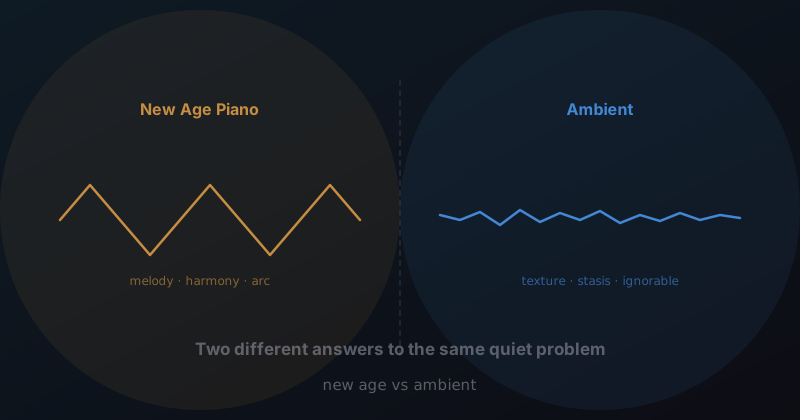
New Age and ambient music often get lumped together — and in streaming playlists and recommendation algorithms, they frequently appear side by side. Both are calm. Both are instrumental or near-instrumental. Both are used for sleep, focus, relaxation, and background listening.
But they are not the same genre, and the differences are compositionally and aesthetically significant. Confusing them leads to mistaken recommendations ("you like Kiraro, so you'll love Eno") that don't serve listeners well.
What ambient music is doing
Brian Eno defined ambient music in 1978 as music that "must be as ignorable as it is interesting." He was describing a specific aesthetic goal: music that functions as an acoustic treatment of space, changing the quality of the environment without demanding attention. His ambient pieces (the Ambient series, The Plateaux of Mirror with Harold Budd) work through accumulation, stasis, and gradual change rather than melody, harmony, and resolution.
Ambient music typically: - Has no consistent melody that the listener follows - Changes slowly, if at all — the sonic environment shifts over minutes rather than bars - Uses texture rather than musical gesture as its primary material - Avoids harmonic resolution (chords don't "go" anywhere) - Is designed to be heard in the room rather than listened to actively
In practice, ambient music occupies the territory between music and acoustic design. Eno's Music for Airports genuinely functions as airport sound design — it is specifically intended for a public space where active listening is impossible and background acoustic quality matters.
What New Age piano is doing
New Age piano has a melody. It follows harmonic progressions. It goes somewhere — rises, falls, peaks, resolves. It has a structure that repeats in a loop. You can hum it.
This is fundamentally different from ambient music. New Age piano is compositional music that happens to be slow, calming, and undemanding. It uses the full vocabulary of Western tonal music — key signatures, chord progressions, melodic phrases, rhythmic regularity — but applies that vocabulary at a pace and dynamic level that reduces its demand on the listener's attention.
New Age piano typically: - Has a singable melody in the upper register - Uses consistent chord progressions (usually I–V–vi–IV or I–vi–IV–V) - Maintains a regular tempo with rhythmic structure (arpeggios, pulse) - Resolves harmonically — pieces have clear tonal centers that feel like home - Is designed to be heard, not just felt in a room
The consciousness question
One way to locate the distinction is in what kind of listening each genre assumes.
Ambient music assumes the listener is partly elsewhere. The music is designed to be effective even when attention is primarily directed elsewhere — it functions acoustically without requiring conscious engagement.
New Age piano assumes the listener is present but resting. The melodies are accessible enough to follow without effort; the harmonies are familiar enough to track without analysis. But the music does expect a listening consciousness — it is saying something to you, and that something is received.
This is why New Age piano works differently from ambient in the same situations. In a deep work session where you cannot afford any portion of your attention to music, ambient is the right choice — it won't pull at you. In a light-focus session (reading, light admin, creative work) where you want to be accompanied, New Age piano provides warmth and direction without interruption.
Where they overlap
The middle ground is real. Hiroshi Yoshimura is the clearest example: his music has melodic content (not just texture), but the melodic phrases are widely spaced and the silences between them are as important as the notes. His work is New Age in its tonal language and ambient in its use of space. Artists like Stars of the Lid operate in similar territory from the ambient direction — textural, not melodic, but deeply emotionally present in ways that pure design-music isn't.
Mowjera's music therapy collection leans ambient in some pieces (Night Calm, Breathing Room with its pure breath-pacing function) and more fully New Age in others (Gentle Steps, Morning Light). The New Age collection sits more firmly in the melodic, compositional tradition — every piece has a singable melody and a clear harmonic arc.
Neither genre is better. They're different tools. The question is which one you need in a given moment, and that requires knowing what each is actually doing.